Digitalization Dangers
In his final report to the UN Human Rights Council, the Special Rapporteur on the right to food Michael Fakhri observed: “Land-related digitalization processes are not generally embedded in human rights. As a result, thus far, digitalization is reproducing, consolidating and even exacerbating existing forms of exclusion and marginalization.” This warning nonetheless encourages further inquiry.
The most ambitious example of collection and control of digitalized land tenure information is the big-data hoarder Jeff Bezos. The primary hazards arising from his Bezos Earth Fund involve large private finance restructuring land governance without direct democratic control by the populations living on that land. When ostensible conservation targets, carbon markets, and philanthropic capital combine, they can convert land into externally governed assets. This convergence can undermine equitable land tenure by concentrating decision-making power and land-governance discourse to restrict local rights, and financializing ecosystems.
The Bezos Earth Fund is a $10-billion private philanthropic initiative directing large-scale conservation and land-use programs across multiple continents. It seeks to direct decisions about millions of hectares of land, forests, and marine territories, rather than the populations legitimately inhabiting those territories. Among the ambitious objectives are pursued through grants funding tens of millions of hectares of new protected areas across the Tropical Andes and creating 7 million acres of protected areas in the Amazon.
What are some of the structural hazards of the Bezos Earth Fund to equitable and sustainable land tenure?
1. Power Concentration without Democratic Legitimacy
In principle, legitimate authority over land must emanate from the people living on it in good faith. International law affirms peoples’ right to sovereignty over their own natural resources. When land governance decisions are driven by philanthropic capital rather than community consent, authority shifts from residents to NGOs and donors, while populations become subjects of an over-riding policy rather than decision makers. That fact alone creates a legitimacy gap in land tenure governance.
2. Conservation Expansion Risks Land Dispossession
Secure land tenure requires that people can live, move and sustain livelihoods on land they historically occupy. Large conservation programs often expand protected areas, which typically restrict subsistence agriculture, settlement, and traditional livelihoods. Such communities stand to lose their equitable and sustainable access to, use of, and control over forests, fisheries, and grazing lands.
The Bezos Earth Fund directly finances the expansion of protected areas in the Congo Basin, the Amazon, and the Andes. That aligns with the global “30×30” conservation goal (protecting 30% of Earth’s land and oceans). However, if 30% of global land were locked into protected regimes without tenure reform, millions of rural and Indigenous residents risk exclusion. Such expansion of protected areas at planetary scale can trigger:
- Conservation-driven displacement,
- Loss of customary land rights, and
- Criminalization of traditional land use.
3. Financialization of Nature and Carbon Territories
As witnessed in the 2012 Rio+20 process, when ecosystems become financial assets, governance follows capital rather than community needs. To wit, many Bezos Earth Fund initiatives support “nature-based solutions,” but critics warn these mechanisms can:
- Convert ecosystems into carbon offset commodities;
- Allow corporations to continue emissions, while purchasing land-based offsets;
- Transform forests into financial assets managed by NGOs or investors, rather than local communities.
The consequence of this trend makes land valuable not for livelihoods but for carbon storage, likely incentivizing:
- external control of forests and pasturelands;
- restrictions on subsistence farming, hunting and gathering;
- commodification of ecological services.
4. NGO Governance Displacing Local Authority
Governance systems must align with local populations` agency mediated with other commitments of states such as ensuring the social and ecological functions of land and the obligation to ensure the “continuous improvement of living conditions” with “the progressive realization of rights”. However, large philanthropic funds often route money through international NGOs, as in the case of the Bezos Earth Fund’s partnership with World Resources Institute (WRI) and its subsidiaries. This creates a governance chain (donor → international NGO → local implementation) rather than: community → local governance → policy.
The donor-driven structure risks:
- NGO technocracy replacing local/sovereign decision making, and
- Community consultations becoming procedural and performative rather than authoritative factors toward formulating coherent policy.
Research on land deals shows consultation often involves elites rather than whole communities, leaving many residents unaware of their rights.
5. Narrative Capture: “Conservation as Universal Good”
Narratives can obscure structural impacts. The dominant narrative around large conservation funds:
- Climate protection,
- Biodiversity preservation,
- Planetary emergency.
These goals are legitimate, but the narrative can obscure a structural contradiction, especially if the narrative is driven by private or geopolitical interests. A narrative that moralizes climate-change mitigation pursued through land control may obviate other priorities of green-house gas emissions (GGE) reduction, including the urgent need to reduce consumption, urbanization and dependence on fossil fuels. If fossil fuel systems continue while land is appropriated for carbon storage, the burden shifts to rural populations rather than industrial polluters. This is already seen in climate-action finance preferencing mitigation over adaptation projects in countries of the Global South, which are not the main source of GGE.
6. Philanthropic Governance Bypassing Public Accountability
Systems controlling land must be accountable to those affected. Private philanthropic funds and other non-state actors are not. They are not elected, not publicly accountable, and operate according to donor priorities. Yet they influence land governance across Africa, Latin America and the Pacific. This dynamic exerts private geopolitical influence over global land systems.
7. Mismatch between Global Targets and Local Rights and Interests
Given the sheer scale of money and influence asserted by Bezos Earth Fund, as a prime example, the pursuit of its global land-management goals risk to over-riding local land rights. Planetary targets such as 30% land protection require enormous territory, including territories already inhabited.
WRI’s Bezos-funded subsidiary LandMark claims to have mapped 35.8% of the world`s land and natural resources “held or used by Indigenous Peoples and local communities, out of an estimated 50% or more that experts project is actually held or used.” LandMark’s online community-level map layers help visualize Indigenous and “community” lands and territories, and display national-level map layers to visualize country summaries of land rights information.
However, the organization pursues an exclusively technical approach to mapping, without the normative guidance that would clarify what is meant by “Indigenous Peoples” as distinct or conflated with “local communities.” This shortcoming is most obvious in regions such as the Middle East and North Africa, where governments (i.e., Morocco) promote conflation of the two terms in order to derogate Indigenous Peoples’ land rights, or refuse to recognize the existence of Indigenous Peoples as such. In the same region, LandMark also lacks vocabulary or classifications of various state lands, military lands or royal lands, all of which are considerable in scale across the region, while corresponding spatial data are also hard to come by. The LandMark mapping exercise risks sparking conflict with all authorities concerned, including the actual Indigenous Peoples, all of whom are reluctant to subject their definition of territories and tenure types to external agents.
8. Resulting tensions
The private harvesting of data on global land tenure adds layers to already-existing tensions over land and its governance. Its pursuit of global conservation targets is perceived as interfering in local livelihood systems. Without normative frameworks and structural safeguards, conservation expansion can replicate colonial land patterns in digital form, whereby external actors define land values and uses, and local populations are managed or relocated.
The stated goal of the Bezos Earth Fund is to “protect ecosystems and climate stability.”
However, the structural mechanism used is large-scale conservation finance controlling land. The hazard is that if land governance shifts from communities to external institutions, the system risks reproducing the same extractive power structures that created the ecological crisis in the first place.
Equitable and sustainable land tenure still requires:
- Community sovereignty over land decisions,
- Legal recognition of Indigenous and customary land rights,
- Direct funding to community governance institutions,
- Climate policy focused on emissions reduction first,
- Conservation co-governed by local populations.
Where those conditions exist, conservation and land justice can align. Where they do not, large conservation funds risk producing green land concentration rather than ecological justice.
In his final report to the UN Human Rights Council, the Special Rapporteur on the right to food Michael Fakhri advised states to:
Put particular emphasis on marginalized people, taking into account their rights and needs.
Respect, protect and promote all legitimate tenure rights, as well as different forms of tenure, especially collective and customary tenure and management systems.
Guarantee effective participation by all tenure rights holders at all stages of the digitalization process, in particular organizations representing marginalized people and rural communities.
Ensure that land-related digitalization processes are supportive of broader policy objectives, such as realization of the right to food and nutrition, poverty eradication, social stability and justice, and rural development, as well as the sustainable use of land and related resources.
Refrain from using digital land registries or cadastral systems to extinguish unwritten or collective tenure claims.
Guarantee non-digital, accessible alternatives for land registration and allocation, and dispute resolution.
Treat land and tenure data as a public good, ensuring transparency, community oversight and protection from corporate capture.
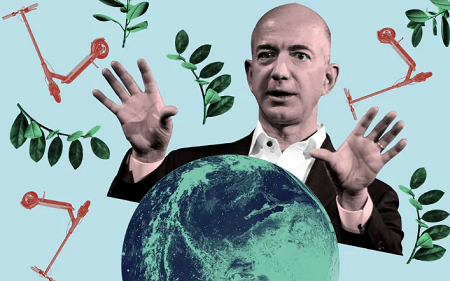
Image: Jeff Bezos superimposed against a Nature Conservancy banner. Source: Bloomberg/Getty Images.
|