Achieving Housing and Land Policy Coherence in Uganda
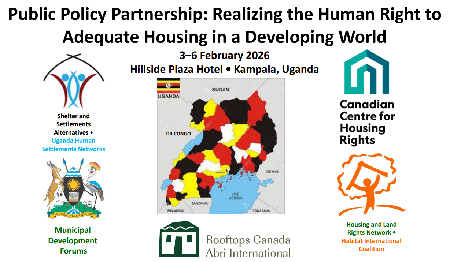
Ugandan civil society has demonstrated how to cooperate with various spheres of government to co-produce housing and land policy. Shelter and Settlements Alternatives (SSA) organized a technical workshop in Kampala, from 2 to 6 February 2026, with the support of Rooftops Canada and Global Affairs Canada (GAC), under the theme: “Public Policy Partnership: Realizing the Human Right to Adequate Housing in a Developing World.”
With SSA’s executive director Dorothy Baziwe and project manager Brian Odella hosted the four-day course, participating Ugandan legal practitioners, civil society representatives and public servants explored, in turn, Uganda’s related international and regional African Union (AU) human rights treaty obligations. This was followed by an inventory of Uganda’s relevant development commitments within the global 2030 Agenda and the AU’s development-and-decolonization Agenda 2063: “The Africa We Want.”
Since the 4-day capability-development workshop took place within the Rooftops-supported “Women’s Spaces” project in four African countries (Angola, Kenya, South Africa and Uganda), aligned with GAC’s Feminist International Assistance Policy, women’s land and housing rights and development formed a key focus. The process incorporated international and pan-African perspectives with Habitat International Coalition’s Cairo-based Housing and Land Rights coordinator Joseph Schechla providing the normative framework and Ademofe Oye-Adeniran (Nigeria/Canada) sharing policy-engagement experiences and lessons in the Canadian context.
One of the practical objectives was to apply the theory to actual practice and align these general lessons to the specific context of Uganda. To that end, Ministry of Lands, Housing and Urban Development’s Human Settlements Commissioner Khayangayanga Dave presented Uganda’s housing and land rights legal and policy context. SSA’s Peter Kasaija, also showcased the organization’s own progress at legal and policy advocacy. Relating to the participant’s common-but-differentiated functions, the program culminated with the participants co-producing professional policy briefs on their self-determined problem-solving housing and land rights priorities in the country.
Projects like “Women’s Spaces” with such actives as this build women’s and men’s common knowledge and skills (capabilities) vital to achieve equitable and sustainable access to, use of, and control over land. When grounded in the associated human rights, they not only operationalize the normative framework for such efforts, but also develop the fit-for-purpose tools we all need to sustain coherent social, economic and environmental functions of land. In their broadest application, these tools are the instruments of statecraft that uphold civic peace, ensure meaningful participation of a policy’s ultimate subjects. Such a pragmatic human rights approach thus contributes to the development-state system and a more coherent world order.
In these four days, the official and civic partners developed knowledge together with a common language that promises to enhance mutual understanding across the seeming policy divide. The fruits of this discovery of complementary norms and methods will be thus subject of further reporting by SSA.
To me, the most impactful learning moments were in the participants’ feedback, indicating a high degree of receptivity to the material prepared for them. They absorbed and correctly used new terminology and concepts and seemed to grasp the practical nature of the human rights principles and obligations, once explained. The most meaningful—and, hence, impactful—lesson may have been the introductory session, by focusing on human rights to housing and land as practical guides for coherence of the system, avoiding collapse into injustice, deprivation and violence. The multiplier effect of that approach can be seen in its applications to other fields of public life and human needs.
In the interim, technical advisor Joseph Schechla observed that, “in this experience, its seems that the public servants, who could then see their own human rights obligations as tools of their profession, beyond moralizing language expressed in rules imposed by remote authorities.” He added that “It was encouraging to witness such cooperation between government official and conscientious citizens, showing that a better world is possible.”
Image: Title screen from the “Public Policy Partnership” materials. Source: HIC-HLRN.
|