Fakhri’s Food Focus on Land
The Special Rapporteur on the right to food Michael Fakhri begins his final report to the Human Rights Council’s 61st session by paraphrasing Mahmoud Darwish: “On the land is where we find what makes life worth living.”
However, he observes that, like during the financial crisis of 2008 and 2009, corporations and financial investors are turning their attention to large land acquisitions and speculation. The current rush to grab land is creating, or exacerbating massive inequality in access to, use of, and control over land. This dispossession of land-dependent people leads to massive inequality of wealth and to systemic hunger, poverty and violence. And land concentration both results from and begets violence. (see Sudan article in this Land Times/أحوال الأرض).
Much as there was the European colonial “scramble for Africa” during the late nineteenth and early twentieth centuries, the Special Rapporteur is referring to a rural-land rush around the world that accelerated in 2007, around the time of the food crisis. From the perspective of people living on those lands, the resulting violence and displacement by private actors results in the same displacement and dispossession caused by national laws and policies, and by belligerent occupation of territory by another state.
He reports that, today, 1% of the world’s farms control 70% of the world’s agricultural land, naming the world’s top 10 transnational landowners, who together control 404,457 km2 – an area larger than Japan:
(a) Blue Carbon (United Arab Emirates),
(b) Macquarie Group (Australia),
(c) Olam Group (Singapore),
(d) Manulife (Canada),
(e) Arauco (Chile),
(f) Shell (United Kingdom of Great Britain and Northern Ireland),
(g) TIAA/Nuveen (USA),
(h) Edizione (Italy),
(i) Wilmar International (Singapore).
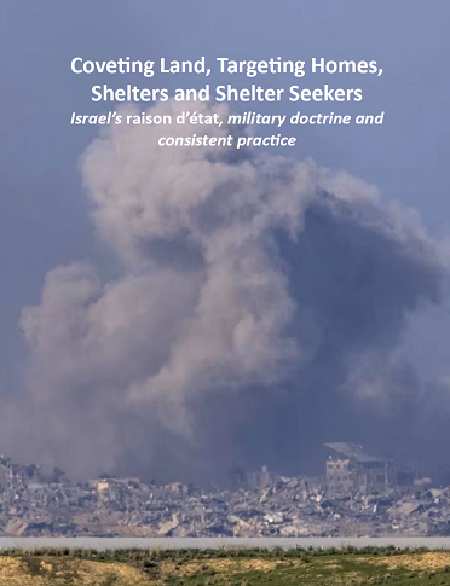
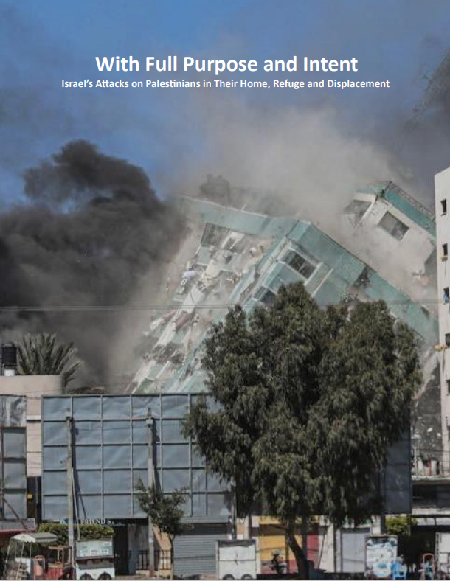
The report cites how laws of Argentina and Nicaragua exemplify how states use legislation to violate peoples’ right to food, land rights and right to land. It also recounts how the ongoing genocide in Palestine that Israel accelerated in October 2023 has involved the deliberate and systematic destruction of land and the environment. Over 95% of Gaza’s agricultural land has been rendered unusable. By mid-2025, 97.1 per cent of tree crops, 82.4% of annual crops and 95.1% of shrubland had been destroyed. Over 1,200 agricultural wells and thousands of farms, greenhouses and irrigation systems had been ruined. Less than 5% of cropland remains cultivable or accessible.
These forces are exacerbated by environmental degradation as well. Across Mali, South Africa, the State of Palestine and Venezuela (Bolivarian Republic of), desertification is not an external environmental shock. It is shaped by specific legal and economic regimes.
Fakhri offers a rights-based reading of the Convention to Combat Desertification (UNCCD) that implies three directions:
1. Land-degradation data, land degradation neutrality targets and national action programs should be treated as evidence of structural injustice in food systems, not just as environmental indicators. Where degradation is concentrated in the territories of peasants, Indigenous Peoples and rural workers, the core question is how land, water and seeds are controlled and for whose benefit. Monitoring under UNCCD should be explicitly linked to states’ obligations under ICESCR’s article 11 and UNDROP
2. UNCCD implementation should be assessed against benchmarks derived from human rights obligations: secure and equitable access to, use of, and control over land and water resources; protection of customary and communal tenure; support for agroecology and other peasant-led forms of production; and meaningful participation by affected communities, including rural women, in decisions about land, restoration and finance.
Land degradation neutrality and other restoration initiatives that enclose a commons, displace communities or privilege corporate actors over peasants and pastoralists should be treated as contrary to the object and purpose of the Convention.
3. In situations such as in the State of Palestine, where desertification is directly linked to occupation, annexation and colonial settlement, compliance with UNCCD cannot be evaluated separately from international humanitarian and human rights law. Fakhri points out that a state cannot plausibly claim to be fulfilling its obligations to combat desertification while simultaneously destroying seed systems; agricultural infrastructure; and access to, use of, and control over the occupied population’s land and water; or the prohibition against environmental degradation as a method of warfare and population transfer.
Photo: The edge of a corn field. Source: UVA Today.
|