HIC Advocates for the Urban Food Insecure
HIC continues to be an advocate for the urban food insecure constituency in the Civil Society and Indigenous Peoples Mechanism (CSIPM) for relations with the Committee on World Food Security (CFS). As the principal UN policy-making body for the Rome-based implementation agencies (FAO, IFAD and WFP) concerned with food and agriculture, CFS underwent a major reform in 2009, which resulted in the democratization of that body by enabling stakeholders to participate [AR] in the relevant policy-making processes. Until now, CSIPM remains the exemplary self-organized stakeholder engagement with substantive input into the global agenda on food and nutrition.
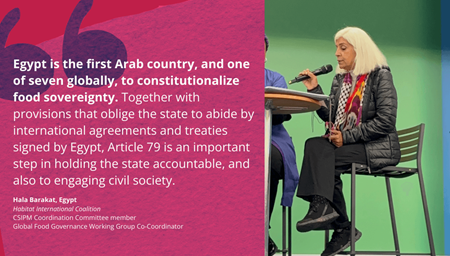
Throughout 2023–26, Sam Ikua (Mazingira Institute, Kenya and Hala Barakat (Egyptian Initiative for Personal Rights) participated in the coordination of the Urban and Peri-Urban Food Systems working group that was following the 2024–25 CFS workstream on strengthening urban and peri-urban food systems. Mr. Ikua assisted in coordinating the working group to develop policy positions and discuss them within the CSIPM. The proposals were also shared with the constituency for input. Apart from drafting the proposals, HIC was engaged in live negotiations on the text of the policy with CFS actors. This workstream culminated in the CSIPM supporting the endorsement of the Policy Recommendations for Strengthening Urban and Peri-urban Food Systems by CFS member states. The working group also produced an enlightening vision document for urban and peri-urban food systems.
In addition, HIC representatives engaged in the co-coordination of the Global Food Governance working group (December 2025–May 2026). The working group’s mandate is on following complex topics related to food governance that cannot be discussed within the CFS ordinary policy processes. He was able to link the concerns of the urban food insecure constituency with the corporate capture of food systems and how this is undermining the human right to adequate food and food sovereignty.
Through participating in these working groups, HIC representation enables the negotiating partners to appreciate the connection between right to food and the collective priorities of urban residents toward a holistic implementation of the habitat-related human rights, including adequate housing, food, water, a clean, healthy and sustainable environment to achieve a human rights habitat.
Sharing CFS policy products through events
In March 2026, Mazingira organized a CBO-sensitization forum in Nairobi on the CFS policy products. That focused on the CFS Guidelines on the Right to Food and the CFS peri-urban food system recommendations. The participants developed their understand these two CFS policy products and how they can be localized and implemented in Nairobi.
Throughout 2025, HIC representatives participated in the Global Food Governance Reform working group, including an April 2026 workshop organized by Institute for Agriculture and Trade Policy, in collaboration with the Brazil National Council for Food Security and Nutrition. The objective was to develop plans to strengthen CFS to realize its mandate within the context of FAO reform.
Conclusion
Lessons from this mandate point stress the need for continued coordinated advocacy for the implementation of the human right to food and other related rights, especially within the context of interconnected crisis comprising corporate capture, economic contraction, authoritarianism, climate change, and rapid population growth amid declining natural resources.
Photo on the front page: From left, Ximena Moreno (Brazil), Hamadi Mbali (Mali), Aasha Ramesh (India) and Samuel Ikua (Kenya) at CFS negotiations for policy recommendations on urban and peri-urban food systems. Source: CSIPM. Photo on this page: Hala Barakat, speaking on behalf of CSIPM at CFS 52 Plenary Session. Source: CSIPM.
|