Seven Months in Kashmir
This report covers the Indian-occupied territory of Kashmir by type of housing and land rights violation over the past seven-month period of reported violations (October 2025–April 2026). This structure makes visible the underlying occupation policy architecture as it systematically deprives the Kashmiri people—in particular, the Indigenous Muslim majority—of its habitat.
To understand the longer-term patterns of the Indian occupation’s violations of Kashmiris’ housing, land and environmental rights, readers are encouraged to read this in conjunction with the serial reports in Land Times/أحوال الأرض linked in annex below.
This review period begins with ten UN Special Rapporteurs (SRs) jointly expressing grave concern and requesting responses from Indian authorities to recent mass arrests and detentions, use of force, extrajudicial executions, house demolitions and forced evictions, restrictions on freedom of expression and journalism, increased surveillance and harassment of Muslims in Indian-occupied Kashmir (IoK), as well as recent deportation of Muslims, including Rohingya refugees. The SRs publicized their findings on 24 November.
After India was elected to the UN Human Rights Council (HRC) on 14 October, civil society urges India to align with human rights standards, including the minimum requirements of HRC member states. Among their demands, global human rights organizations called on the Government of India to accept, with no further delay, all pending country-visit requests by the UN Special Procedures, including to Indian-administered Kashmir, during its 2026–28 membership period, repeal the Jammu and Kashmir Public Safety Act and ensure that military personnel suspected of having committed serious human rights violations are brought to justice in fair trials before civilian courts.
Indian authorities continued to deny free expression, including through prosecutions for social media posts amid escalating land expropriations and related habitat violations, including by constructing a military base in a nature preserve, 43 new high-altitude military bases and four new railway lines.
Meanwhile, India continues to deny the return of nearly 800 previously deported people for alleged PAK or Pakistani origins or backgrounds, continuing to split families with no prospect of reunification.
1. Home Destruction
November 2025
Indian occupation forces demolished the home of journalist Arfaz Daing`s parents in Narwal, Jammu district. Authorities had previously demolished Arfaz Daing`s own home in Bathindi.
During the night of 13–14 November in south Kashmir’s Pulwama, Indian security agents detonated the home of Dr. Umar Nabi, whom security agencies suspected of having driven an explosive-laden car at Red Fort on 10 November. The blast displaced at least eight neighboring families, damaging their homes. Meanwhile, Kashmir’s chief cleric, Mirwaiz Umar Farooq, in his 14 November Friday sermon, urged the Indian occupiers to revise their methods in Kashmir.
Indian forces used bulldozers to demolish the house of an alleged drug smuggler’s brother in Bishnah, Jammu District.
December 2025 – April 2026
The reports document no additional specific house demolitions during this period, but property confiscation and land seizure intensified.
2. Home Confiscation and Property Seizure
October 2025
Indian Jammu and Kashmir Police expropriated the office building of Tehreek-e-Hurriyat in Hyderpora, the family home of Sheikh Sajjad in Srinagar, and lands belonging to Nazir Ahmad Ganie and Fayaz Ahmad. The Unlawful Activities (Prevention) Act (UAPA) was the administrative tool used to justify the seizure.
November 2025
On 12 November, the Jammu and Kashmir Police confiscated the home and land of prominent lawyer and former Kashmir High Court Bar Association President Mian Abdul Qayoom in Srinagar.
December 2025
Counter-Intelligence Kashmir (CIK) initiated property confiscation against activists Tony Ashai, Mubeen Shah, and Rifat Wani.
March 2026
Indian occupation forces expropriated the property of Mohd Qasim in Reasi district.
April 2026
The NIA expropriated a home and multiple lands belonging to Fayaz Ahmed Magray in Lethpora, in Awantipura Police Station, Pulwama District
The NIA expropriated the property of Tafazul Hussain Parimoo in the SK Bagh area of Budgam district.
3. Forced Eviction and Displacement
November 2025
Thousands of Kashmiri students and professionals in India faced intensified collective suspicion, harassment, denial of basic services and evictions.
April 2026
Indian occupation authorities banned Jamia Siraj-ul-Uloom, authorized seizure of its assets, and forcibly relocated its students.
4. Land Expropriation
October 2025
On the orders of New Delhi-imposed administration’s Lieutenant Governor Mano Sinha, Indian occupation forces expropriated multiple landholdings, including land belonging to Nazir Ahmad Ganie in Palpora village of Kralgund, Kupwara districts, and 3 kanals* and 19 marlas† (1,653m2) of land belonging to Fayaz Ahmad of Dasan, Beerwah, Budgam district under the premise of the UAPA. The same tool was used to expropriate a three-storey residential house and 15 marlas of land (315m2) worth Rs 2 crore at Rose Avenue Colony in Srinagar’s Zainakote.
November 2025
New Delhi-appointed Lieutenant Governor Manoj Sinha ordered the confiscation of ancestral land belonging to Mubashir Ahmad in Tral, and initiated property-expropriation proceedings against US-based activist Ghulam Nabi Fai under the draconian UAPA.
Indian authorities are establishing another Central Reserve Police Force (CRPF) base spanning 1,324 kanals (≈67km2) within the Zabarwan Conservation Reserve in Nishat, Srinagar, part of Dachigam National Park’s protected catchment area. Official data showed continued transfer of land ownership to non-local buyers.
December 2025
On 23 December 2025, the special National Investigation Agency (NIA) court directed the District Collector of Budgam to officially take possession of immovable properties of Dr. Ghulam Nabi Fai in Budgam district, which more than 1.5 kanals (759 m2) of land across the villages of Wadwan and Chattabugh.
Indian occupation forces expropriated 1 kanal and 16¼ marlas (506.268m2) of land belonging to Zahid Hussain in Doda district.
Farmers in Pulwama, Shopian and Anantnag districts protested the planned expropriation of their prime agricultural land for new railway lines and a new Border Security Force base, which foreshadow grave economic and environmental impacts.
Official Indian data demonstrate that Kashmir has already lost nearly 34,000 hectares (340km2) of farmland between 1996 and 2023, resulting in loss of livelihoods and severe food insecurity and diminishing food sovereignty, with increasing dependence on imported rice.
January 2026
Indian occupation forces expropriated 4 marlas and 2 sarsai (105.79m2) from Rafiq Nai in Nar, Mendhar, Poonch district, and six kanal 13.5 marlas (3,264m2) from Jamal Lone of Chamber Kanari, in Mandi tehsil, Poonch district.
February 2026
Within two weeks, CRPF announced plans to construct a base on 1,668 kanals (0.337912 km2) of land within Dachigam National Park, a major wildlife refuge and a “greenbelt” (no construction zone); to establish 43 additional bases across Indian-occupied zone at altitudes between 3,000 and 6,000 feet; and to construct four new railway lines involving mass expropriation of land, including prime agricultural land.
Indian occupation forces rejected 39,898 Forest Rights Act claims, denying Kashmiri communities legal recognition of their land rights.
April 2026
Kashmir Times reported that the state had expropriated more than 140,000 kanals (17,500 acres) between 2019 and 2025.
5. Land Degradation and Environmental Destruction
October 2025
Participatory Urban Design and Development Initiative (PUDDI) published analysis of how mining has stripped Kashmir’s riverbeds, eroding groundwater recharge, drying springs, shrinking trout habitats, and endangering the fragile Himalayan ecosystems. As extraction from rivers and streams continues unchecked, springs have dried and entire communities are losing dependable water. Sand and mineral extraction doubled from 474,000 metric tonnes in 2021–22 to 1,142,000 metric tonnes in 2022–23, driven by infrastructure projects like the Delhi–Katra motorway. Kashmir’s mining revenue reached Rs 181.04 crore (≈€16,384,971) over the past five years. But the study concluded that the environmental costs may prove far greater, but remain yet unquantified.
November 2025
Indian occupation forces offered limestone-mining rights across 314 hectares in Anantnag, Rajouri, and Poonch.
Riverbed mining destroyed freshwater systems, livelihoods, trout habitat, and water access.
State-promoted industrial projects generated pollution and ecological damage.
December 2025
On 19 December 2025, illegal mining caused a landslide in Khanpora, Baramulla district.
Witnesses recorded and exposed large-scale illegal deforestation in Drung–Danwasarea, Tangmarg. The Forest Department alleged these to be the acts of timber smugglers.
Indian occupation forces continued projects that degraded ecology, water systems, livelihoods, and agricultural land.
January 2026
Illegal mining destroyed hundreds of acres of agricultural land and livelihoods in Pulwama and Budgam.
Reports revealed how freshwater springs and other culturally significant water sources continued to decline.
February 2026
Indian occupation authorities continued to facilitate illegal riverbed mining and soil extraction that caused losses of land, crops, and livelihoods.
March 2026
Indian occupation forces expropriated land measuring one kanal and 12.5 marlas (≈822.17m2) located in the Fidarpora village, which is recorded in the name of Khurshid Ahmad Dar in Sopore.
Mining operations continued to destroy fertile agricultural land, livelihoods, and rural ways of life.
April 2026
Kashmir Times reported that cumulative land expropriation had already driven loss of agricultural land, livelihoods, ecological stability, and food security across Kashmir.
6. Settler Colonization
October 2025
The J&K Legislative Assembly’s Revenue Department published findings that, since 2019, 631 buyers from outside the Indian-occupied territory have purchased Kashmiri land measuring over 386 kanals (195,261 m2). These land transactions by non-residents collectively amounted to Rs 129.97 crore (≈€11,762,896) between October 2019 and 2025.
March 2026
On 10 March 2026, Indian authorities announced the completion of 4,128 out of 6,000 planned accommodations for pro-BJP Hindu settlers in Indian-controlled Kashmir.
April 2026
Kashmir Times reported that the construction of 30 new satellite townships, industrial estates and the Jammu Ring Road have taken 191,730 kanals (≈97km2) of Kashmiris’ land. The Ring Road corridor cuts through 52 villages in six central Kashmir districts, which have been designated no-construction zones, freezing Kashmiri farmers` ability to sell, develop, or even improve their land. The law bans construction within 500 meters on either side of the highway around Srinagar.
Other railways and highways such as the Udhampur-Srinagar-Baramulla Rail Link combine to foreclose at least 11,600 additional kanals (≈5.87km2).
Structural Patterns
Indian occupation forces and institutions use home demolition as a punitive and administrative measure to deny housing and property to Muslim Kashmiris whom the occupation authorities deem to challenge India’s occupation and/or its policies, especially those. The common legal and administrative tool used against that group is the UAPA. However, during the review period, the demolitions targeted journalists, relatives of suspects, and families associated with alleged “political” or “security” breaches. The Pulwama demolition extended punishment beyond the targeted household by damaging neighboring homes and forcibly evicting resident families.
The Indian occupation has repeatedly carried out real-property confiscation against political activists, human rights defenders, journalists, organizations, and individuals accused of security offenses. The pattern has shifted from isolated seizures to a sustained administrative system of dispossession since 2019.
Forced evictions have operated through multiple mechanisms of occupation: Direct removal with demolitions, exclusion from return, demographic restructuring through colonial settlement, investment programs, and forced relocation linked to institutional closures. These measures govern who may access, reside on, use, and exercise control over land in Kashmir, favoring (Hindu and other non-Muslim) outsiders.
Land expropriation has evolved from individual seizures into territorial restructuring. Indian occupation forces use military expansion, railway construction, conservation-area conversion, denial of forest rights, and demographic engineering to transfer control over land away from Indigenous communities and toward state institutions, military infrastructure, and favored settler populations.
Environmental degradation has functioned as a land-rights violation in cases where a duty holder is responsible for causing or aggravating foreseeable harm. Mining, deforestation, military infrastructure construction, railway expansion, and extractive development have systematically reduced access to productive land, freshwater, food production, and livelihood systems. The cumulative effect has exceeded environmental harm and directly undermined the material basis of community survival and territorial continuity. The cumulative pattern constitutes the Indian state’s incremental acquisition of territory by force since 2019.
* A kanal is equivalent to 505.857m2.
† A marla is equivalent to 25.2929 m2.
Previously in Land Times/أحوال الأرض:
“Occupier’s Law, Kashmiris’ Land,” Issue 33 (October 2025)
“Kashmir: Demolitions, Land Dispossession and Degradation,” Issue 32 (May 2025)
“More Kashmir Land Deprivation,” Issue 31 (December 2024)
“Kashmir Occupation Update,” Issue 30 (July 2024)
“Taking Kashmir Land under Indian Occupation,” Issue 28 (April 2023)
“Peoples Denied Self-determination Converge,” Issue 19 (April 2020)
قوانين المحتل، والأراضي الكشميرية
كشمير: سياسات الهدم والتجريد وتدهور الأراضي
حرمان كشمير المزيد من أراضيها
طورات بشأن إقليم كشمير المحتل
الاستيلاء على أراضي كشمير الواقعة تحت الاحتلال الهندي
تقارب الشعوب المحرومة من حق تقرير المصير
Search and submit Kashmir cases in the Violation Database (1990–present)
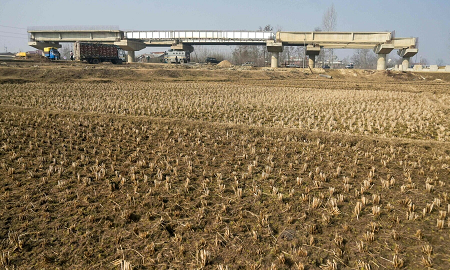
Photo on front page: Kashmiri rice farmer Musadiq Hussain speaking to AFP on 15 January 2025 from his disused land within the 500-meter easement of the Baramulla Highway construction. Source: AFP/File. Photo on this page: Picture taken on 15 January 2025 showing the under-construction Srinagar ring road in Baramulla, occupied Jammu and Kashmir. Source: AFP/File.
|