Domicide Dimensions of Genocide
The legal definition of genocide has become common knowledge as an outcome of Israel’s escalated genocide in Palestine since October 2023. In particular, the public understands that the “intent to destroy, in whole or in part, a national, ethnical, racial or religious group, as such” includes “Deliberately inflicting on the group conditions of life calculated to bring about its physical destruction in whole or in part.”
The final report of the UN Human Rights Council’s first Independent International Commission of Inquiry on the Occupied Palestinian Territory, including East Jerusalem, and Israel, provided a “Legal analysis of the conduct of Israel in Gaza pursuant to the Convention on the Prevention and Punishment of the Crime of Genocide.” The Commission reports the “reasonable grounds that the Israeli authorities and Israeli security forces have committed and are continuing to commit the following actus reus of genocide against the Palestinians in the Gaza Strip.” Among those grounds are gross violations of the humans right to adequate housing, including grand-scale forced evictions amounting to population transfer.
Amid the patterns of displacement, dispossession and destruction in Gaza, readers should be reminded that these actus rei are perpetrated within the context of Israel’s settler colonialism, apartheid and sustainable elimination of the Indigenous Palestinian People, with population transfer as its raison d’état.
The Commission three kinds of attacks on homes (i.e., domicide):
- killing through attacks against protected objects (such as civilian homes and healthcare facilities) where civilians were present;
- targeting civilians and other protected persons, for example, during the evacuations, within safe zones or at shelters; and
- deaths due to the deliberate infliction of conditions of life (such as the blockade of medicine and medical equipment and humanitarian aid from entering into Gaza).
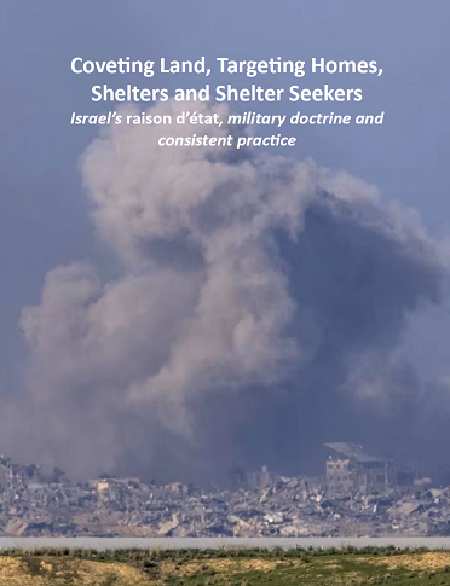
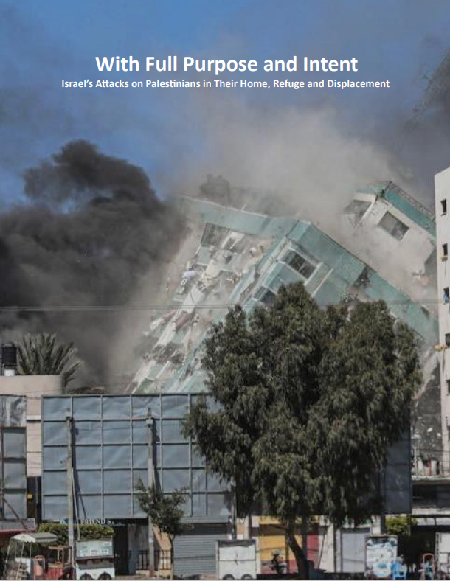
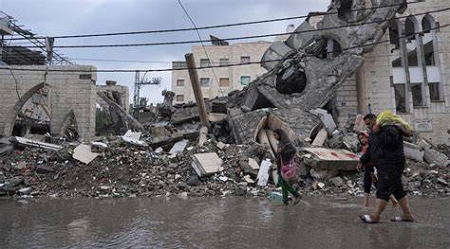
The Commission explains how Israel has used heavy unguided munitions with a wide margin of error in densely populated residential areas, leading to the complete destruction of neighborhoods. Israeli targets included high-rise buildings and residential apartment blocks, levelling entire city blocks and high-rise apartment buildings and residential neighborhoods under sustained heavy bombardment. On many occasions, these bombardments killed almost all the civilians therein. One military expert observed, “Israel is dropping in less than a week what the United States was dropping in Afghanistan in a year, in a much smaller, much more densely populated area.” The pattern continues from the Commissions previous report covering October and December 2023.
The report cites 224 Israeli strikes on residential buildings and tents for displaced people in the Gaza Strip between 18 March and 9 April 2025. Some 36 strikes killed only women and children.” Israeli forces has targeted and killed Palestinians along evacuation routes and in safe zones, including women and children, even in the absence of hostilities in the vicinity and when they were by themselves.
Israeli forces had already concentrated approximately 2.3 million residents into 360km2, densifying population to 6,300 persons per km2, among the densest globally. Then they were found to target the very densely populated civilian locations in Gaza.
Israeli forces attacked shelter seekers along their evacuation routes and within designated Israeli-designated safe areas. The Commission found that the perpetrators had clear knowledge of the presence of Palestinian civilians there, but nevertheless their snipers shot at and killed civilians, including children and toddlers, shot in the head.
The report notes that “forcible transfer is not considered a genocidal act in itself,” but that this actus rea has caused serious and irreparable physical and mental harm to Palestinians in Gaza who have lost their homes and have been forced to live in inhumane conditions. In the wider habitat sphere, the Commission highlights the Israeli forces’ deliberate destruction of the Gaza environment through their military operations and risking long-term health problems amid the debris from the large-scale destruction of buildings.
The Commission previously concluded that Israeli forces repeatedly transferring civilians across the Gaza Strip by:
(i) Forcing inhabitants to flee their homes, fearing for their safety;
(ii) Humiliating, degrading and attacking shelter seekers throughout their evacuation;
(iii) Forcing the population to live in inhumane conditions at overcrowded shelters lacking healthcare and basic provisions such as clean food and water;
(iv) Attacking displaced civilians along evacuation routes and in areas designated as safe zones; and
(v) Prohibiting civilians from returning to their homes.
Additionally, it is reasonable to conclude that victims who were displaced have suffered and are suffering serious mental harm. As such, the Commission concluded that the forcible transfer of the civilian population in the Gaza Strip also amounted to cruel or inhuman treatment, both of which are war crimes.
The Commission notes that “the term ‘conditions of life’ may include, but is not necessarily restricted to, the deliberate deprivation of resources indispensable for survival, such as food or medical services, or systematic expulsion from homes.”
Therefore, the Commission finds that the extensive and systematic destruction of Palestinian homes and structures in Gaza, including agriculture lands and other properties that are indispensable to Palestinian life, supporting the conclusion that Israel’s military operations were part of the intent to destroy Palestinians in Gaza. The centrality of attacking homes, shelters and shelter seekers to Israel’s military doctrine give specificity of how domicide contributes to the composite crime of crimes.
Photo: Palestinians wade in rainwater as they walk past a destroyed mosque on the first day of the Eid al-Fitr festival marking the end of the holy month of Ramadan, in Dhayr al-Balah in the central Gaza Strip on 10 April 2024. Source: AFP.
|