Systemic transformation now and forever!
A Common Political Action Agenda in Near East and North Africa (NENA)
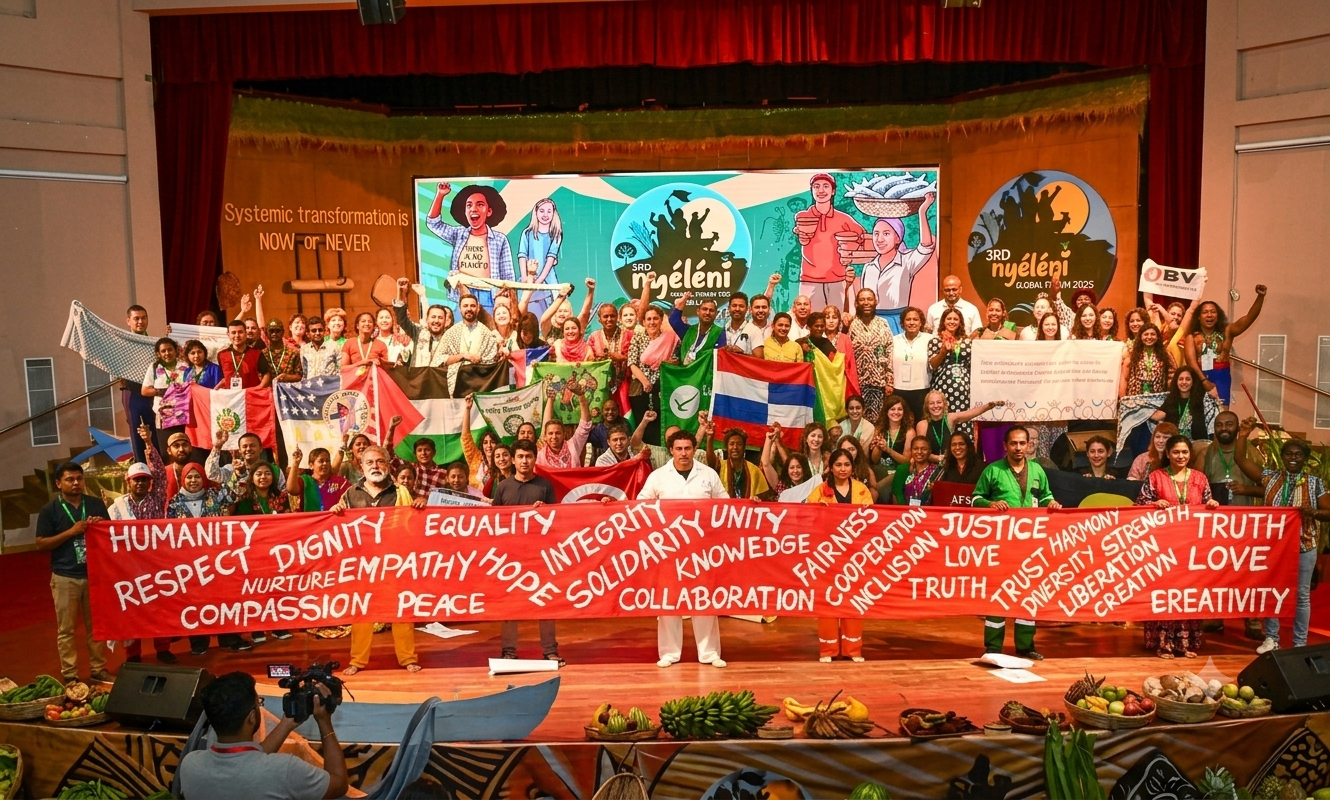
The Food Sovereignty International Planning Committee (IPC) has for 30 years convened diverse farmers, fishers, civil society organizations, social movements, and Indigenous Peoples organizations engaged with food issues and rights of small-scale food producers. After six years of planning, IPC organized the Third Nyéléni Global Forum (Nyéléni III) last September near the city of Kandy, Sri Lanka. It sought to build the food sovereignty movement and diffuse the principles articulated in the formative 2007 and 2015 gatherings at the village of Nyéléni, Mali.
Nyéléni III broadened participation in the food sovereignty movement, including movements concerned with public health, sexual diversity, climate justice, and solidarity economy more generally. It also applied the Nyéléni Principles to the broader struggles under the theme “Systemic transformation now and forever!”
The development of the global get-together, often referred to as the “Nyéléni process” produced a catalogue of positions and corresponding goals articulated in a “Common Political Action Agenda” (CPAA). The “action” remains a future prospect to be strategized in forthcoming processes. The CPAA principles and analysis resemble foregoing IPC iterations. Forsaking those, and now reconsidering needed implementation actions, the IPC General Meeting will convene in July 2026 to deliberate once again.
IPC member organizations, including HIC, in the SWANA/MENA region have reiterated that a Nyéléni process round was not their region’s priority, especially amid raging wars of starvation and related crises. Despite conspicuously pro-Palestinian symbolism and rhetoric at Kandy, this action phase leaves no time for further navel gazing.
In this context, HLRN, operating in IPC as HIC-MENA, devotes its efforts within IPC to supporting the time- and other cost-intensive CPAA toward the needed transformation of work methods that the Nyéléni III theme implies.
This article contributes a SWANA/MENA regional habitat-rights perspective on CPAA implementation. The following inventory also memorializes decisions already taken over a decade of engagement with global IPC and FAO’s Near East/North Africa (NENA) office, as well as more-recent consultations with constituents across the region.
Societies in NENA can hardly be described as enjoying sovereignty in any sense, let alone food sovereignty. This shortcoming is especially evident in the vital domain of a people’s means of subsistence, where even the minimum requirements to fulfill the human right to food remain precarious.
Regional priorities
SWANA/NENA is a diverse region, but commonly faces specific urgencies related to food sovereignty, including:
- A protracted displacement crisis: 54,255,400 displaced persons in the region are entitled to reparations, including 11.6 million internally displaced persons in Sudan.
- Overall, 59 million people in the region are in need of humanitarian assistance without prescribed remedy.
- Climate change: 3,155,913 people live in climate-induced displacement, most linked to flooding, in addition to 19 million people expected to be displaced internally as a result of slow-onset climate change effects.
- Inflation and rising prices of food and agricultural inputs, alongside increasing extreme poverty: 40% of the region’s population suffers from multidimensional poverty; 66.1 million people — nearly 14% of the population of the Arab region — suffer from hunger; and 186.5 million experience moderate or severe food insecurity.
- Weak governance of land and insecure tenure: 78 million people in the region feel insecure about their land and housing tenure rights, compounded by a lack of recognition of the full diversity of tenure forms, particularly traditional and customary tenure.
- Land acquisition for water-intensive agricultural investments: Foreign land investments cover 1.76 million hectares; of 78 land deals analyzed in the Arab region, only five reported on consultations with local communities, and only one complied with the principles of free, prior, and informed consent.
- Accelerated urbanization: The expanding built environment puts increasing pressure on limited water, land and energy resources that reduces local food sovereignty, lengthening supply chains, increasing costs and deepening disparity in the ability to afford food.
Remedies
Across the region over time, local stakeholders have been expanding alliances and networking with other civil society actors (academics, legal practitioners, media, and others) can pool expertise to address policy gaps by applying food sovereignty principles in the confront neoliberal policies through:
- Distinguishing the state’s political commitments from binding legal obligations
- Aligning states’ relevant political commitments with human rights treaty obligations to guide actual practice
- Critically reviewing policy advice and contributing to policy and norm
- development
- Proposing a regional observatory for food sovereignty, since the 2016 regional CSO Consultation with FAO/RNE, as a framework for coordination and knowledge production
- Promoting coherence among policies related to food and agriculture issues and the rights of small-scale farming families
- Demanding social protection, particularly for women working in the agricultural sector, smallholder farmers, and small-scale farming families
- Assessing loss and damage for victims of land rights violations, environmental hazards and climate change impacts, as well as conflicts, occupation and war
- Demanding reparations for those victims, including those in protracted crises
- Community-informed knowledge exchange, co-production and data collection.
Urgent priorities
With already-deliberated and adopted policy instruments, the region’s stakeholders have been calling for urgent implementation of the Framework for Action for Food Security and Nutrition in Protracted Crises (FFA), Voluntary Guidelines on the Responsible Governance of Tenure of Land Fisheries and Forests (VGGT), and the UN Declaration on the Rights of Peasants and Other People Working in Rural Areas (UNDROP), especially through the current UN Decade of Family Farming. In addition, they have called for:
Negotiating regionally specific Responsible Agricultural Investment Principles to end current modes of intra-regional land grabbing at the expense of small-scale farmers and local sovereignty;
Applying the human rights-based discipline in the deliberation and implementation of equitable agrarian policy commitments;
Building consciousness about land rights as a condition beyond mere “access” (i.e., land as a human right to “equitable and sustainable access to, use of, and control over [a.k.a. democratic management of] land”);
- Reforming land governance and the recognition and legal protection of all legitimate forms of land tenure (i.e., the “continuum of land rights”), including traditional and customary tenure, to institute fairness, peace and stability;
- Building civil society’s technical capacities to enable more-effective engagement prevention and response strategies, adaptation and mitigation policies, and in monitoring, documenting, protecting and restoring communities affected by climate change and destructive market forces;
- Achieving meaningful participation along the ladder of engagement;
- Implementing Housing and Property Restitution for Refugees and Displaced Persons: Implementing the Pinheiro Principles in The Middle East and North Africa
- Closing the gender-equality gap in access to, use of, and control over land and productive resources.
Full and conscientious participation with key international civil society structures, including:
- The Food Sovereignty International Planning Committee (IPC)
- The Civil Society and Indigenous Peoples Mechanism for relations with the Committee for World Food Security (CSIPM)
- The Boycott, Divestment, and Sanctions (BDS) campaign
- The Extraterritorial Obligations Consortium (ETOs)
- Mutual engagement with, and convergence among habitat actors, developing mutual understanding among urban, rural and Indigenous social movements
- Supporting the global campaign for a binding UN treaty on business and human rights, to ensure corporate accountability across global supply chains, and to prevent and remedy related violations.
Linkages with other thematic areas
Indeed, putting forward a genuine and implementable action plan covering all points raised above will require us to engage with other thematic areas, including:
- Strengthening the feminist approach and restoring women’s rights as a steadfast political priority, after these rights have receded across all political agendas
- Promoting the principles and practice of agroecology, within the broader vision of food sovereignty
- Promoting the human right to health for all, by monitoring and combatting all destructive pests affecting the region’s food systems;
- Promoting the human right to adequate housing for all, especially respect for the continuum of land rights and a human right to land, within the prohibition against forced eviction, the social function of land and states’ related voluntary commitments and binding obligations;
- Monitoring the role of multinational corporations and their third-party, extraterritorial, international cooperation and assistance obligations in current contexts.
The Nyéléni process was supposed to spark ambitious demands for “systemic transformation.” The obvious and repeated call for rescinding the UN Security Council veto did not survive the CPAA editing process at Nyéléni III and since.
While Nyéléni III convened, the Global Sumud Flotilla was sailing to break the starvation siege in Gaza, so far away from Kandy.
|